

Pakistan Opens Indus AI Week With Landmark AI Summit, Announces USD 1 Billion Commitment to Artificial Intelligence by 2030
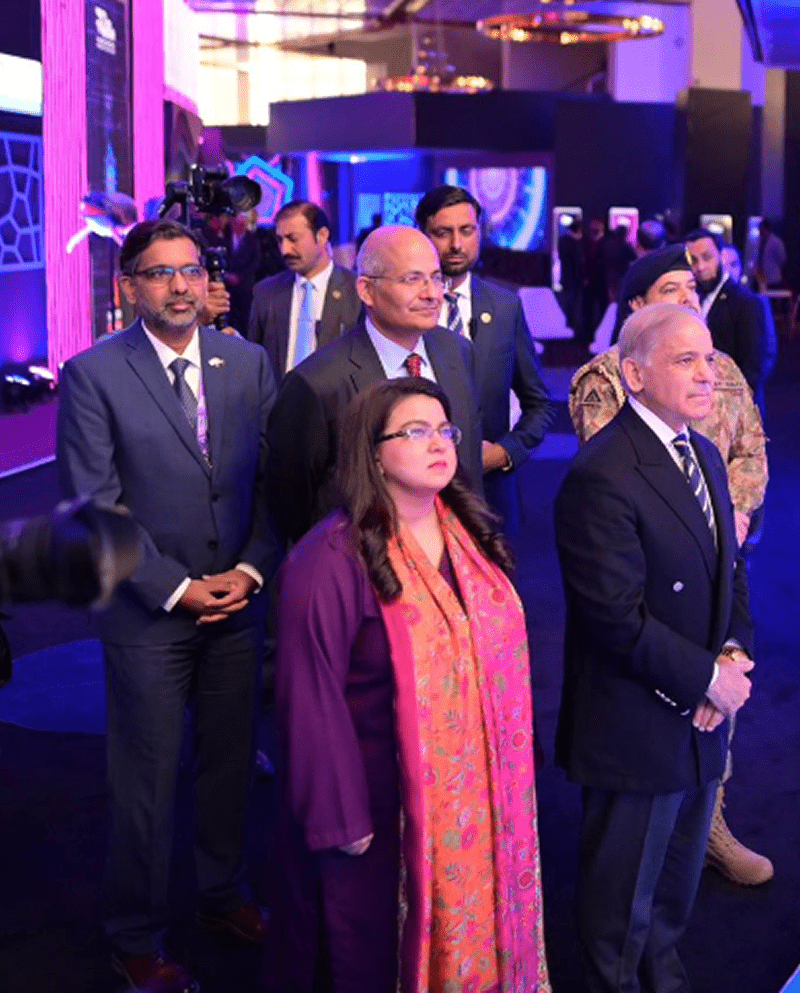
ISLAMABAD, 10 February 2026 — Pakistan formally opened its national artificial intelligence agenda with the Indus AI Summit 2026, held on February 9 at the Jinnah Convention Center, marking the beginning of a new phase in the country’s digital and technological evolution. Organized by the Ministry of Information Technology & Telecommunication, the Summit was attended by the Prime Minister of Pakistan as Chief Guest, alongside Federal Minister for IT & Telecommunication Shaza Fatima Khawaja, and senior leadership from across the public and private sectors. Serving as the policy and leadership anchor of Indus AI Week, taking place from 9 to 15 February 2026, the Summit set the direction for Pakistan’s transition from AI policy development to large-scale implementation and adoption. The one-day gathering brought together more than 1,000 participants, including 150 international delegates, for high-level dialogue on sovereign compute, global collaboration, and the strengthening of Pakistan’s national digital ecosystem. In his address, the Prime Minister identified Pakistan’s youth as the country’s most critical strategic asset and announced a USD 1 billion national commitment to artificial intelligence initiatives by 2030. He emphasized that artificial intelligence is no longer a future aspiration, but a present-day driver of economic growth, governance reform, and national competitiveness. He reaffirmed Pakistan’s resolve to actively shape the global AI landscape rather than merely observe its transformation. Federal Minister Shaza Fatima Khawaja highlighted the government’s recent legislative and institutional progress toward digitisation and extended an open invitation for international collaboration. “Pakistan invites global technology companies, research institutions, venture capital firms, multilateral partners, and governments to engage with us in a structured and sustained strategic dialogue,” the Minister stated. During the Summit, the Minister formally unveiled the Islamabad AI Declaration, articulating Pakistan’s position on sovereign, inclusive, and responsible artificial intelligence. The Declaration outlines eight strategic pillars covering public value, human accountability, pragmatic use-case delivery, data privacy and trust, safe and explainable AI, whole-of-government governance, inclusive innovation, and a private-sector-led AI ecosystem. The Summit featured keynote contributions from international leaders including Dr. Aisha Bin Bishr of The Global Diwan and Dominic Williams, President of the Dfinity Foundation, alongside academic and industry experts from Asia, Europe, and North America. Strategic dialogues throughout the day focused on AI governance, financing sovereign AI infrastructure, and building competitive national ecosystems. Following the Summit, Indus AI Week 2026 continues with its next phase at the Innovation, Learning, and Engagement Arena at the Pakistan Sports Complex. Over the coming days, developers, startups, students, industry leaders, and the public will participate in hands-on innovation, skills development, and collaborative programs across the country. Running through 15 February, Indus AI Week signals the start of Pakistan’s long-term commitment to artificial intelligence as a cornerstone of economic transformation, institutional strengthening, and international partnership.
PSEB Launches Strategic Study to Develop Shenzhen-Inspired ICT Education and Training Roadmap for Pakistan

Islamabad, Pakistan – The Pakistan Software Export Board (PSEB) has launched a strategic initiative to strengthen Pakistan’s digital workforce and enhance IT export competitiveness through a study titled “Shenzhen-Inspired ICT Education and Training Roadmap for Pakistan.” The contract signing ceremony was held in the presence of the Honourable Federal Minister for IT and Telecommunication, Ms. Shaza Khawaja, marking a key step toward aligning Pakistan’s education and training ecosystem with global best practices. The agreement was signed between PSEB and Alliance PKU Management Consultants (ALLPKU), with Chief Executive Officer of PSEB, Mr. Faisal Jeddy, and Chief Operating Officer of ALLPKU, Mr. Hank (Xianyang) Shao, representing their respective organizations. The initiative is aligned with the vision of the Prime Minister of Pakistan, Mr. Shehbaz Sharif, to accelerate the growth of the digital economy by strengthening linkages between academia, industry, and innovation. It aims to position Pakistan as a globally competitive hub for information and communications technology talent. Drawing on the globally recognized model of Shenzhen, one of the world’s leading technology and innovation ecosystems, the study will assess how integrated education and industry collaboration can drive workforce readiness and economic growth. It will deliver actionable recommendations to modernize Pakistan’s ICT education and training landscape, enabling the development of a future-ready workforce and supporting sustained expansion in IT exports. This initiative underscores PSEB’s commitment to fostering innovation, building human capital, and advancing Pakistan’s position as a leading destination for global technology investment and services.
Pakistan Establishes Its Sovereign AI Position with the Adoption of the Islamabad AI Declaration
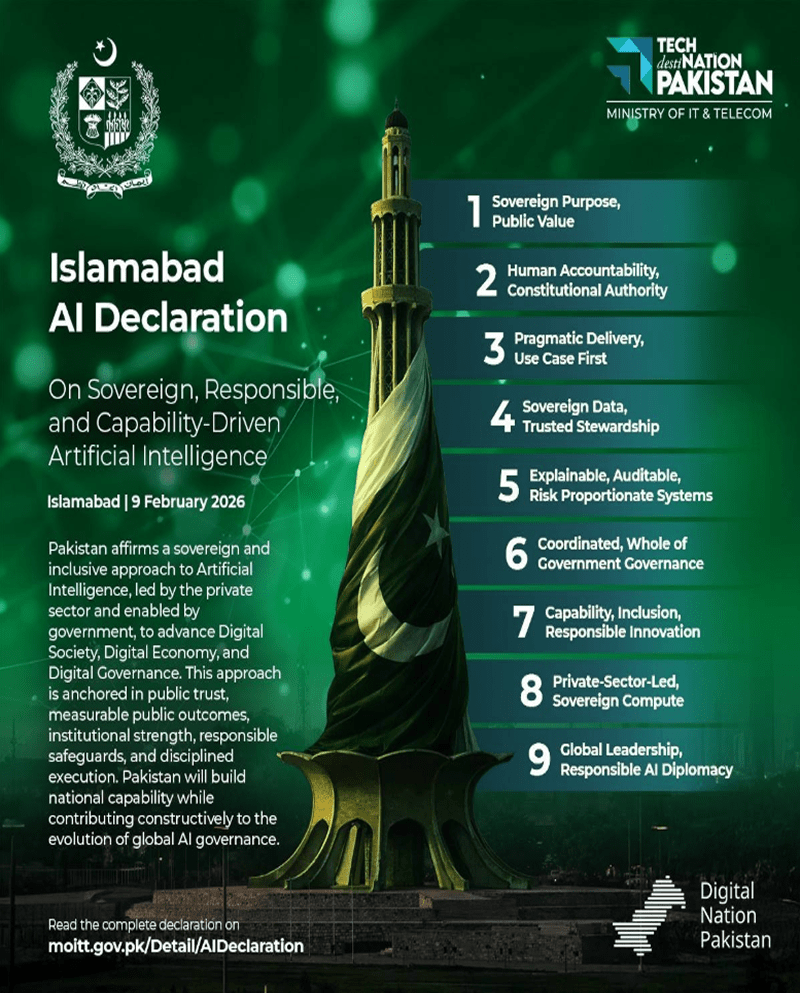
Islamabad, Pakistan — Following the high-level proceedings of the Indus AI Summit 2026, the Government of Pakistan has formally adopted the Islamabad AI Declaration on Sovereign, Responsible, and Capability-Driven Artificial Intelligence. The Declaration defines Pakistan’s national position on Artificial Intelligence and marks the transition from policy articulation to disciplined national execution. Formally presented by the Federal Minister for Information Technology and Telecommunication, Ms. Shaza Fatima Khawaja, the Declaration affirms Pakistan’s sovereign and inclusive approach to Artificial Intelligence, led by the private sector and enabled by government, to advance Digital Society, Digital Economy, and Digital Governance. The Declaration sets out nine foundational principles that will guide Pakistan’s national AI ecosystem: AI as a sovereign choice aligned with constitutional objectives and measurable public value Human accountability and institutional oversight in all decisions of public consequence A pragmatic, use-case-first deployment model anchored in economic productivity and service delivery Sovereign data stewardship under Pakistan’s legal and constitutional framework Explainable, auditable, and risk-proportionate AI systems Coordinated, whole-of-government governance to prevent fragmentation and vendor dependency Investment in national capability, research, and inclusive innovation A private-sector-led AI economy supported by sovereign compute and resilient infrastructure Principled international engagement consistent with national values and sovereign interests Federal Minister for Information Technology and Telecommunication, Ms. Shaza Fatima Khawaja, stated: “The Islamabad AI Declaration is a foundational step in strengthening Pakistan’s digital economy. Under the Prime Minister’s vision to harness AI for public good and economic growth, this framework provides a disciplined roadmap to create jobs, enable enterprise, and build long-term competitiveness. Our youth are our greatest strategic asset, and AI will be a catalyst for inclusive prosperity.” Dr. Sohail Munir, Chairperson of the Pakistan Digital Authority, the national authority responsible for AI governance, regulatory oversight, and supervisory coordination in Pakistan, added: “The Declaration establishes the foundations for AI governance and supervision in Pakistan and reflects a disciplined commitment to sovereignty, public trust, and measurable national value. Pakistan will adopt AI responsibly, govern it rigorously, and build domestic capability with accountability. The Ministry of Information Technology and Telecommunication, in coordination with the Pakistan Digital Authority and relevant federal and provincial institutions, has initiated the integration of the Declaration’s principles into supervisory frameworks, procurement standards, sectoral adoption roadmaps, and institutional capability programs. The Honourable Prime Minister has directed the Pakistan Digital Authority to operationalize and enforce a national AI Supervisory Framework aligned with the Declaration and to develop the necessary legal and governance architecture to ensure structured, accountable AI adoption across the country. With this adoption, Pakistan formally enters a new phase of sovereign, responsible, and capability-driven AI development.